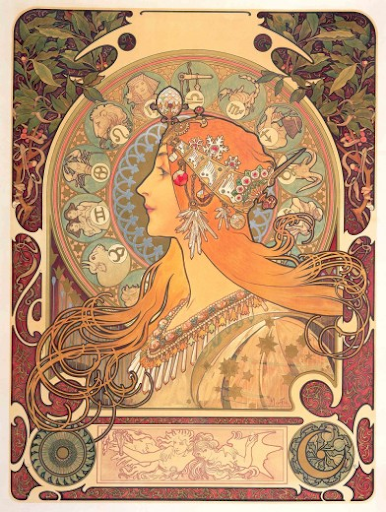
Art Nouveau: a distinct style characterized by flowing lines, natural themes, and a stark contrast to previous Western art movements. Popularized in the 1890s, this movement has its roots in Japanese prints in the ukiyo-e style, which originates as early as the 1600s. This style was characterised by natural motifs, movement, and color printing. After two centuries of isolating themselves from foreign trade, Japan re-opened its ports in 1868, causing an influx of these ukiyo-e prints in western Europe.
At a similar time, the Arts and Crafts movement was becoming prominent in the United Kingdom. With the great shift toward industrialism, this movement sought to return to a more simplistic, naturalistic style, evident in artists such as William Morris. The resurgence of color lithography was a large factor in the changing art world as well, providing a distinct look that was becoming increasingly widespread. This combination of ideas influencing the European art world in the latter half of the 1800s led to the emergence of the Art Nouveau movement, which drew from the natural themes of both influences and created a distinct style.
Early works, like the prints of Henri de Toulouse-Lautrec, are often heavily influenced by Japanese prints, which is clear in their use of color, movement, and line art. The style evolved as the 1890s went on, with artists like Jules Chéret bringing a slightly more western feel to the previous, heavily Japanese inspired look. As the natural element took hold later on, artists like Alphonse Mucha began to rise to prominence, introducing the style that now comes to mind when we think of Art Nouveau. It began to peter out as the Twentieth Century dawned, fading away and being fully out of style by the time the Art Deco movement emerged around the 1920s—but the mark left on the art world will last forever.