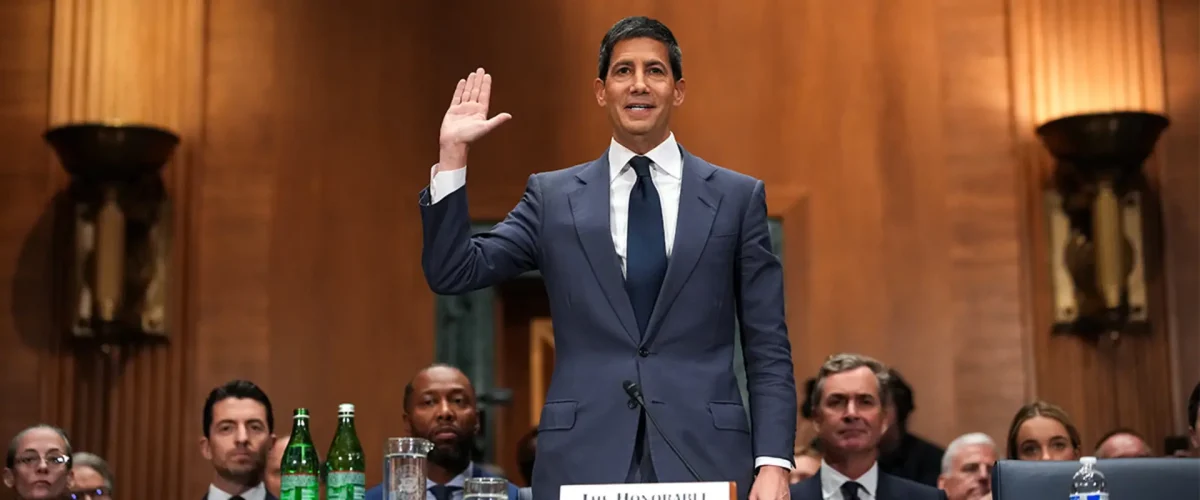
On May 13, 2026, Kevin Warsh was confirmed by the U.S. Senate to replace Jerome Powell and become the 17th chair of the Federal Reserve Board of Governors. However, concerns over Warsh’s confirmation persist as President Trump continues to rally for lower interest rates while inflation remains over the Fed’s 2% mandated target, general sentiments believing that it is susceptible to rise at the moment. So, what does this mean? What is the Fed? Who is Kevin Warsh? And what does his confirmation potentially implicate about the future health of the American economy? Such questions will be addressed in this article.
In 1913, Congress passed the Federal Reserve Act which created the U.S.’ modern central bank, the Federal Reserve (Fed), to further stabilize the American banking system. However, over time its economic responsibilities and role in monetary policy expanded, most notably with the adoption of its dual mandate in the 1970s. The Fed’s dual mandate is to keep prices stable (low inflation) and maintain full employment (low unemployment) within the economy. Such goals are obtained through the Fed’s monetary policy in which the Fed manipulates interest rates to either rise or fall. Higher interest rates discourage investors from taking out loans, which often means that businesses receive less investments, and are used to lower inflation. Lower interest rates encourage investors to take out loans, which often means businesses receive more investments, and are used to increase employment. However, the Fed’s dual mandate is hard to achieve because unemployment and inflation generally have an inverse relationship when responding to monetary policy, as illustrated by the Philips Curve, where lower unemployment leads to greater inflation and vice versa. Furthermore, the Fed is only concerned with the economic well-being of the nation, and for it to maintain this focus and not be affected by political bias, the Fed is an independent regulatory agency, meaning that it operates outside of the direct control of Congress or the Executive Branch, allowing it to operate with non-partisan leadership. However, concerns have been raised about the Fed’s independence with President Trump’s insistence on lowering interest rates, and Warsh aligns with his sentiment.
Despite this article’s outlook of Kevin Warsh, he is a pretty qualified nomination for chair, notably demonstrated by the fact that he was a former governor of the Fed, nominated in 2006, who worked alongside Ben Bernanke, who was chair at the time, to help address the Great Recession. However, concerns about Warsh do not necessarily stem from his professional experience, but rather the potential of partisan influence and his proposed policy.
Warsh was nominated by President Donald Trump and was confirmed by a highly partisan vote, aside from Democratic Senator John Fetterman of Pennsylvania, of 54 to 45 in the Senate. Furthermore, Warsh’s father-in-law Ronald Lauder is a close friend of President Trump and is the same person who helped propose the idea that the United States should annex Greenland. Such developments certainly bring up concerns about the Fed’s independence and insulation from partisan influences from affecting it to make the best possible decisions, but it should be noted that Warsh maintains that the Fed should maintain “strictly independent,” as reported by CNBC.
In terms of policy, however, Warsh aims to lower interest rates, which are in line with President Trump’s sentiments, but aside from politics, such a policy could be unfavorable to the well-being of the American economy. Considering how inflation is sitting above 3% as reported by Fortune, above the Fed’s targeted 2%, and how inflation is expected to rise further because of tariffs imposed by the Trump administration and the conflict with Iran, lowering interest rates does not seem like the wisest choice to make in order to address price stability.
When diving into the concerns surrounding the Fed’s new chair, there are several additional factors and viewpoints to consider than merely the increasingly divisive nature of politics that are hard to fully include with a limited word count, which is why this article should only be interpreted as a simplified overview of such concerns regarding Kevin Warsh as chair.