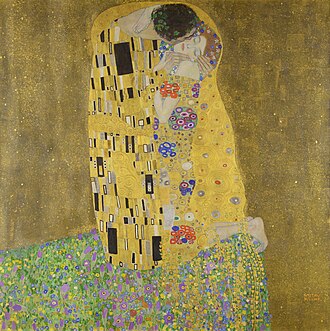
Gustav Klimt’s The Kiss remains one of the most recognizable images in global art. It is frequently seen today on social media, posters, phone wallpapers, and modern design. Its origins are rooted in the artistic and cultural movements of early 20th-century Central Europe, where new styles like the Vienna Secession and Jugendstil were reshaping how art expressed emotion, beauty, and modern life.
At the time, Vienna was one of the major intellectual and artistic centers of Europe, where new ideas in philosophy, music, and visual art reshaped the traditional culture. Within this environment, artists began breaking away from academic styles that emphasized strict realism and historical subjects. In 1897, Gustav Klimt helped found the Vienna Secession, a group dedicated to redefining art in a more modern and expressive direction. Another major influence during this period was Jugendstil, the German-language form of Art Nouveau, which emphasized flowing organic lines, decorative patterns, and the idea that art should extend into everyday life. Klimt’s work reflects these influences through its strong focus on ornamentation and symbolic meaning, blending fine art with the decorative style characteristic of Jugendstil. This movement created the foundation for works like The Kiss, where emotion and visual design are just as important as realistic representation.
The Kiss combines decorative gold leaf, flattened space, and intricate patterning characteristic of Jugendstil, creating a scene that is intimate and timeless. Instead of realism, Klimt emphasizes emotion and symbolism: the embrace is a universal expression of love and vulnerability. This shift towards subjective experience was central to broader modernism, which increasingly valued inner psychology over external realism.
The influence of this movement extended well beyond Vienna. In Germany, artists associated with Expressionism, such as Ernst Ludwig Kirchner and Wassily Kandinsky, pushed these ideas further. Their styles became more distorted and abstract, but the emotional intensity and rejection of academic tradition can be traced back to the same cultural shift that produced Klimt’s The Kiss.
In the United States, The Kiss gained widespread recognition much later, especially through museum exhibitions, reproductions, and popular culture. Unlike its original context (where it is represented as a break from tradition) it is often seen in America as a universal symbol of romance. Its gold-leaf aesthetic has been widely reproduced in posters, merchandise, and design. Still, its emotional clarity resonates with American audiences.
Today, The Kiss is recognized around the world, but its most important impact can still be seen in how it reflects the broader shift toward modern art in German-speaking Europe. Klimt’s focus on emotion, symbolism, and breaking away from traditional academic realism was part of the larger Vienna Secession movement, which helped reshape what modern art could look like. While he did not directly influence every later German Expressionist artist, his work contributed to the same cultural break from tradition that groups like Die Brücke and Der Blaue Reiter also responded to in Germany. These artists pushed modern art even further by using distortion, bold color, and abstraction to express inner emotion rather than realistic scenes. In this way, The Kiss sits within the same larger artistic shift that helped lead from Jugendstil decoration to the rise of German Expressionism, marking an important transition in modern European art.