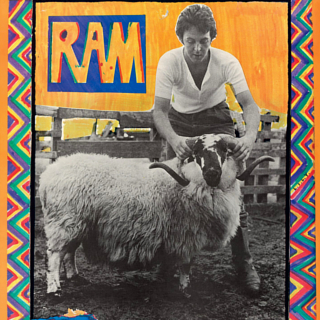
In 1971, former Beatles member Paul McCartney released Ram, an album created during the height of controversy regarding the Beatles’ breakup. Naturally, the album became a major source of debate itself. A year earlier, McCartney received backlash by revealing the Beatles’ breakup through a self-interview—which he used to promote his first solo album McCartney. This reveal angered John Lennon and other ex-Beatle members, who had previously agreed to keep the breakup quiet. Tensions escalated, setting the stage for the controversy that would follow Ram.
Prior to Ram’s release, McCartney stated to have had a “lightbulb moment” that he and his family could simply run away to escape the chaos. They relocated to a farm in Scotland, where they found relief in simplicity and family life. To keep himself amused, McCartney said he would “make stuff up” on his guitar. In contrast to his past musical career, McCartney was creating music by simply seeing what formulated in the moment; while a member of the Beatles, there was extreme pressure to create songs of great importance. McCartney’s new focus was to find himself in his music, and it is evident that his ability to create melodic masterpieces was not diminished by the Beatles’ separation. This laid-back approach resulted in Ram, a record characterized by playful, layered harmonies and pastoral imagery—a sharp contrast from Lennon’s politically driven Plastic Ono Band. Many critics stated that Ram was self-indulgent and lightweight, especially compared to the edgier rock that was popular at the time.
The backlash was vicious. The feud between ex-Beatle members was strong, and Lennon believed that several of the songs on Ram were aimed at him, such as “Too Many People” and “Dear Boy.” He openly stated that he hated the album and mocked it in his own song, “How Do You Sleep?” where he describes McCartney’s work as “muzak to [his] ears.” Former Beatle Ringo Starr also disliked the album, stating that he didn’t think “there’s one [good] tune” and that McCartney seemed “to be going strange.” On early edition postcards for his album Imagine, Lennon is pictured holding a pig’s ears to imitate McCartney’s cover photo for Ram, where he holds a ram’s horns. For years after Ram’s release, many believed it was destined to be remembered as insubstantial and a misstep. Yet, decades later, Ram was reevaluated as one of McCartney’s best works—often named incredibly influential with some even calling it the blueprint for the modern indie-pop sound.
What critics once considered “lightweight” and overly “whimsical” is now assessed as courageous experimentation. The album contains a wide variety of musical styles, which showcases McCartney’s songwriting skills with a sound far ahead of its time. In hindsight, Ram is a representation of McCartney’s freedom from past expectations, a joyous, sometimes chaotic statement of his creative expression and independence.