There are a few plays in football that cause as much debate as the “Tush Push”. Some NFL fans call it an amazing strategy, while others argue that it bends the spirit and the rules of the game. Some people argue that the Minnesota Vikings came up with the concept, while others say the Colts or the Eagles. The origin of the Tush Push can be seen as far back as 2018, when Anthony Barr, a Minnesota Vikings linebacker at the time, suggested “I just think you should put some big dude at quarterback and then another big dude behind him and just push him. Or two guys behind him and double push” (TalkSport). Barr’s explanation of the play is fairly self-explanatory, even for those who aren’t big into football, and essentially created the brotherly shove unknowingly.
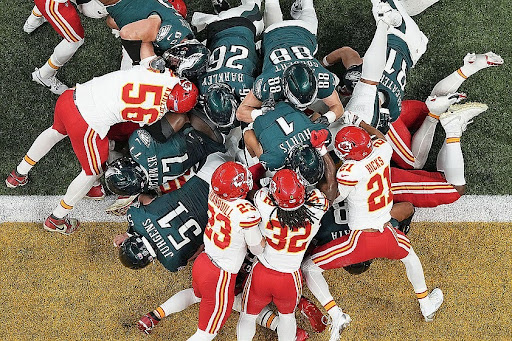
Not too long after that, in 2020, Jacoby Brissett was put in as a sub for the Indianapolis Colts quarterback by their offensive coordinator in a game against the Tennessee Titans with the hope of successfully pulling off the Tush Push. Brissett did the play with ease and was able to score a touchdown, showing that the Tush Push is actually effective despite many other teams attempting to do it and failing rather miserably. Since then, the Philadelphia Eagles have made it their signature move, with their quarterback, Jaylen Hurts. The Eagles have made the play a near-automatic success in short-yardage plays, converting over 90% of attempts in 2023.
Many different NFL analysts have weighed in from all angles on the subject of the Tush Push. Commentator Troy Aikman called the Tush Push “a test of fundamentals, teamwork,” praising its precision and unity. Other analysts like Stephen A. Smith from ESPN have criticized it as “borderline unfair,” arguing that defenses have little chance to counter a play that relies purely on the power and strength of the low leverage. The debate also touches on a deeper question: where should the line be drawn between clever innovation and exploitation of the rules?
Supporters argue that the Tush Push embodies the very essence of football. It’s legal, strategic, and highlights the coordination between offensive linemen and backs. Every inch gained in the play is earned through the practice, timing, and physical will of all the team’s players. To teams like the Eagles, it’s not cheating, it’s adapting. The Eagles have mastered the technique, while the majority of NFL teams fail because it requires not just power but precision. The play has also become a symbol of unity, with players quite literally pushing together towards a shared goal.
Critics, however, see it much differently. Many Coaches and whole teams of the NFL believe that the play creates an unfair advantage as it reduces the defensive skill to irrelevance. Even a few players worry about the increased injury risk, particularly for quarterbacks at the bottom of the pile. Former NFL head coach Mike Vrabel described it as “a rugby scrum for football,” expressing concern that it shifts the game away from athletic finesse toward raw collisions. Defenders argue that the play eliminates creativity, making short-yardage situations predictable and dull to watch.
Despite all of the controversy, the Tush Push has undeniably changed the history of the NFL. It has forced teams to rethink both offensive and defensive strategies. Some coaches have even built specialized practice drills to counter it, focusing on low pad levels and gap control. The play’s success has also sparked some discussion among NFL officials about potential rule changes. For example, there has been some serious talk for the past year of banning the act of pushing a template forward, which was once a prohibited rule in the earlier eras of football, but it was legalized again in 2005 (Reuters). Whether the league reverses that decision could shape how future offences approach critical fourth-down moments.
At the 2025 NFL owners meeting, a proposal to ban the Tush Push narrowly failed; it needed support from 24 owners, but only 22 voted in favor, so the play remains legal (The Washington Post). If the NFL eventually bans the Tush Push or embraces it as part of the game’s future, it has already left its mark on football history. It embodies the ingenuity and controversy that make football such a captivating sport. In the end, the Tush Push isn’t just a play; it is a symbol of football and how it continues to evolve, one shove at a time.